Monday, July 25, 2016

Fermentationist Certification: Ferment 5 ~ Injera

Injera

Doesn't look perfect but tastes perfect!

History:

Teff, the principal grain used in injera was almost lost to the world. It was grown exclusively in Ethiopia for thousands of years, where farmers did not trade their grain with the rest of Africa largely because it was labor intensive to grow. In the 70s the socialist military government insisted that the farmers grow less labour intensive crops to participate in trade and make more money for their state. At this point an American from Idaho, Wayne Carlson, who was fascinated by the growing practices and a big fan of Ethiopian food, brought seeds back home where teff is now grown and sold to local Ethiopian communities.

Today, teff flour is fairly easy to find. Teff is the tiniest grain in the world. It takes 150 teff grains to equal the weight of a single wheat grain!


Health Benefits:

Teff is one of the gluten free grains, along with amaranth, buckwheat, millet, and quinoa.  Teff is packed high with protein, calcium, and iron. In fact, one cup of cooked teff contains as much as the USDA recommends for adults in one day. It’s nutritionally rich because most of the grain is made up of bran and germ, where the nutrients live. The whole grain is made into flour. It takes 150 teff grains to equal the weight of a single wheat grain.

Teff is fermented into injera to increase assimilation. Injera falls into the fermented foods category to increase assimilation. Injera is not fermented for probiotics or for preservation but it makes the grain more nutritious.

Injera at Ethiopian restaurants located in the U.S. is often cut with wheat flour to reduce overall costs. This is because teff is expensive compared to wheat (which is subsidized in the U.S. to reduce the cost to customers). If you are gluten free you should call ahead when ordering injera at an Ethiopian restaurant and request 100% teff injera. Not all restaurants will accommodate this request.

Step by Step:

Gluten Free Teff

  • 1 1/2 Cups water, at room temperature
  • 1 Cup teff flour
  • 1/4 teaspoon salt
  • 1/2 teaspoon baking soda
  • Coconut oil for cooking

Combine:

Combine the teff and water in a small bowl. Whisk until smooth. It will have the consistency
of a thin pancake batter.

Teff Flour mixed with Water


Ferment:

Loosely cover the bowl with a lid/cloth and ferment for two days on the counter or someplace that is about 70 degrees. You should see some rising in about four hours.  Allow to sit undisturbed for 2-3
days then add salt and baking soda and stir.

The mixture will have a yeasty/sour smell. You will also notice small bubbles on the surface now. The baking soda mixes with the acids produced during fermentation. It will help make it less sour. If you like your injera less sour add more baking soda, if you like it more sour, use less baking soda. Stir your mixture.

Cook your Injera


Heat a small cast iron pan over medium heat (you’ll also need a tight-fitting lid). Add about 1/2 tablespoon of coconut oil. Let it melt to medium heat. Pour about 1/2 Cup of batter in the center of the skillet. Tilt and swirl the skillet immediately to coat evenly.

Let the bread cook for about 1 minute, just until holes start to form on the surface. Cover the skillet with the lid to steam the injera.  Cook for about 3 minutes, just until the edges pull away from the sides and the top is set.

Add batter to cast iron frying pan

Cover


Let stand

The first 12 injera's might be a slight disaster because of the excess oil— Don't worry. The
rest of them will get better as you practice!


There is also an injera cooker that you can purchase online. There are many different kinds
and they create a more traditional injera without oil. They cook beautifully and easily with
this grill.  I found a great video demonstrating how to cook injera on a cooker!


US & Canada:  Electric Mogogo Grill
US & Canada:  Electric Mitad Grill  (This company used to have a Canadian version and I no longer see it.  I will update this post once they get back to me on this!)

Progress:

24.06.2016:  Start date ~ started soaking Teff at 9PM
26.06.2016:  Started cooking Injera at 9AM on a gas stove top ~  Success as my 20 month old loved them!  I made served them typical pancake style to get the kids used to it.  Note that I didn't need to use any oil with my well seasoned cast iron frying pan.


11.07.2016:  Update:  I tried injera once again at my mother-in-law's home and she has a flat cook top.  I brought my own cast iron pan and I wasn't able to cook the injera without it sticking with/without oil.  My experiment was a flop this time :(  I think it has to do with the heat that the gas stove top gives.

Thursday, July 07, 2016

Fermentationist Certification: Ferment 4 ~ Dairy & Non-Dairy Yogurt

Yogurt - Dairy & Vegan


One of the oldest and still most popular fermented foods, yogurt is known around the world. The word yogurt comes from Turkey and refers to a tart, thick milk. Yogurt can be found in nearly every culture that kept animals for milk. It was likely discovered in similar ways in each region. When fresh milk is left in a container with friendly bacteria, the milk thickens and develops a delicious sour taste. The lactic acid produced by the fermentation also acts as a preservative.

Yogurt is teeming with bacteria. The bacteria work together to metabolize the milk sugar, or lactose, to form lactic acid, among other chemicals. After fermentation, which can take three or four hours, the mixture will no longer resemble the milk you started with. It will be thicker and creamier.

Bacteria required for fermentation in yogurt are called Lactobacillus (that's the genus) bulgaricus (that's the species) and Streptococcus thermophilus . Store bought yogurt may also have added Lactobacillus acidophilus. Lactobacilli are present in our intestines naturally as long as a healthful lifestyle and little to no antibiotics have been taken. Adding them to yogurt before we eat it helps replenish our supply.

Supplies

Euro Cuisine Yogurt Maker

There are so many methods you can use to make yogurt.  You can use a bowl on the counter, a bowl in the oven with a pilot light on or even a slow cooker.  Because I am so busy and need things to be simple, I purchase a Euro Cuisine Yogurt Maker on Amazon.  I absolutely love it as it is easy for me. Euro Cuisine has a great video so I will post it below to give you the steps needed.


STEP BY STEP

The first thing you will need is Milk of any kind!  You may use raw milk, pasteurized milk,  coconut milk or any nut milks.

Courtesy of Summer Bock - Fermentation Certification Program

Dairy Yogurt

I used whole milk from our local Dairy Farmer in Thunder Bay - Slate River Dairy.  As my starter, I used their yogurt as well.  Their yogurt is not a thick and creamy style of yogurt and therefore you cannot expect yours to be either.  My favourite starter is a Greek Yogurt from Krema...the kids favourite brand!

I brought the milk to 110 degrees and then let it cool before adding the yogurt.
Then I poured the milk into the cute little cups, turned on the Euro Cuisine and the next morning I put them into the fridge to firm up.


Vegan Yogurt

Below is the basic nut milk recipe:

1 Cup raw almonds, hazelnuts, pistachios, pecans, walnuts, or cashews

Optional:
4 teaspoons honey or a few drops of stevia
1/8 teaspoon sea salt

  1. Place nuts in a large bowl and add water to cover by 2 inches.
  2. Let stand at least 12 hours (this is key for silky, non gritty results; the longer the nuts soak, the smoother the milk will be).
  3. Note: exception for cashews, which should never be soaked for longer than 6 hrs.
  4. Drain nuts; discard soaking liquid.
  5. Purée nuts, agave, salt, and 4 cups very hot water (but not boiling; hot water yields creamier milk) in a blender on high speed until very smooth, about 2 minutes.
  6. Strain through a finemesh sieve into a medium bowl, pressing down on solids.
  7. Discard nut pulp. Thin nut milk with water as necessary to reach desired consistency. 
  8. Now you’re ready to make some yogurt! (Transfer to airtight container and chill until cold if not using right away.)
  9. Refer to chart above for further instructions.  

Coconut Yogurt


I had some time and didn't have my nuts soaked so I decided to try some coconut yogurt.  I had two cans of organic coconut milk in the cupboard so I brought this up to 110 degrees and then added 1 tablespoon of Vital Proteins Gelatin and once cooled down, I added the starter culture from Cultures For Health.  I was just messing around without really using any instructions at all and it worked out perfectly!

You may buy starter cultures through www.culturesforhealth.com.  You may find the Vegan Yogurt instructions here.


My yogurt was a little thick but I absolutely loved it!  I may try without the gelatin next time for an experiment however I truly like to add gelatin to everything I can for healing purposes.

I have to say that I love my little cups.  I take them to work for a snack each day!  If you do order a Euro Cuisine, buy an extra set of cups so you can constantly have the yogurt maker on!  We need it as the kids love yogurt...

Progress:

Dairy Yogurt

18.06.2016:  Start date ~ started yogurt maker at 7PM
19.06.2016:  Considered harvesting today but decided to leave it longer so the bacteria would digest most of the lactose.
20.06.2016:  Harvested at 7AM and put into the fridge for the day.  I found it still too runny.

Coconut Yogurt

25.06.2016:  Start date ~ started yogurt maker at 5:30 PM
26.06.2016:  Harvested at 1PM.  It had separated which is normal for vegan style yogurts so I stirred them all before putting them into the fridge.  They came out very thick but that is what I loved about it!
Update:  I tried another batch of coconut yogurt without any gelatin and found it too runny even after I took it out of the fridge.  I will have to start experimenting with my gelatin to get the exact quantity needed for a true yogurt consistency. I would also like to experiment with vegan options as well (agar agar powder or arrowroot powder).


Fermentationist Certification: Ferment 3 ~ Miso

MISO

Miso is a Japanese form of fermented bean paste.  It is made by mashing well-cooked beans with koji (grain grown with the mold Aspergillus oryzae), salt and often mature miso (also known as seed miso).  Miso is one of the few fermentation processes that is purely a fungus.

White Miso made with soy beans & both Barley & Rice Koji


The benefits of eating Miso are plenty so I will only list a few!

  • Inexpensive source of protein, probiotics, and minerals
  • Longevity: a bowl a day keeps the doctor away
  • Amino acid profile similar to meat
  • Contains vitamin B12
  • Alkalineforming
  • (makes the body more alkaline)
  • Prevents radiation sickness
  • Helps detox heavy metals
  • Cancer protective
  • Neutralizes environmental toxins
  • High in enzymes
  • Low in phytates
  • Improved digestibility

KOJI

Koji is the inoculant that is used to start the process of fermentation derived from the Chinese word meaning “moldy grain.” Koji is rice infused with the mold (all molds except slime and water molds are a type of fungus), Aspergillus oryzae . It provides all the enzymes necessary to break down substrates into metabolizable products.  

If you want to make your own koji, you can learn this in the Art of Fermentation authored by Sandor Katz.  


I purchased my Koji through Cultures for Health, www.culturesforhealth.com : Search for either Organic Brown Rice Koji (gluten free) or Traditional Barley Koji (depending on your preference).  I purchased both as I wanted to experiment with the taste of each.


Organic Rice Koji & Traditional Barley Koji

THE MISO SONG

You cannot make Miso at home without listen to The Miso Song! 

 "Sing and dance along to making miso at home! The hand drawn animation is a play along song video with a charming melody and cute characters. you can enjoy your very own “musical workshop for homemade miso”. Experience the “homemade miso” culture that is traditionally inherited throughout the regions of Japan. Taste the deep, rich culture of fermentation and discover the joy of making your own homemade."


STEP BY STEP


Although Soy is the traditional bean, some people don’t want to eat or cannot eat soybeans. Using the red miso recipe, you can replace the soybeans with any other kind of bean. Black beans, mung, adzuki, pinto, you name it.  You can use this same general procedure with a different bean to
make any kind of miso you desire.

WHITE MISO

(to make 1.75 Cups)

1/2 Cup dry soybeans
1 Cup dried koji (notice that you have more koji in white miso)
3.33 Tablespoon sea or kosher salt (noniodized)
1 Cup mixing liquid (see instructions below)
Fermenting vessel or ceramic, glass, wooden, or food grade stainless steel crock

Spouted Soy Beans

  1. Soak beans overnight. Beans are best soaked because they contain enzyme inhibitors that can strain the digestive tract when consumed in excess. Soaking makes them easier to digest and their nutrients more readily available. To soak beans leave them overnight in salt water. Salt activates enzymes that neutralize enzyme inhibitors. Discard this liquid and rinse the beans before starting the next step. This is not a traditional method but I let mine sprout!
  2. Cook using a pressure cooker (~20 minutes) or in a pot until soft.
  3. Drain the beans, but save the liquid.
  4. Make a brine using 1/2 Cup of this liquid, dissolve half the salt into it.
  5. While waiting for the liquid to cool, mash the beans into a smooth paste.
  6. When brine is below 105 degrees, mix into the koji. You don’t have to take the temperature because 105 degrees feels hot to the touch. If it is warm to the touch it is below 105 degrees Fahrenheit.
  7. Add the mashed beans and stir well. Create a consistency of a paste by adding as much mixing liquid as needed.
  8. “Grease” the sides of the miso crock with a tablespoon of sea salt.
  9. Sprinkle about 1/2 Tablespoon sea salt onto the bottom of the crock and around the sides. Add the miso to the crock taking care to smash it in fully to the crock so that no air bubbles remain.
  10. Sprinkle remaining salt on top of the miso and cover with seaweed, wax paper, etc.
  11. Place a plate on top of the miso itself and put a weight on top of that.
  12. Cover the miso with a cloth bag to keep the flies out. It will be sitting for 68 weeks optimally if you live in a cooler climate (most recipes suggest 46 weeks. 
    Experimenting with both Rice & Barley Koji
  13. Remember to label your miso with the date as you WILL forget!
  14. When ready to harvest, scrape off the top yucky layer and behold the glorious deliciousness!
  15. Blend it in a food processor with a little water because the koji grains will still be hard from having fermented for a short period of time. This creates a smooth paste that is easy for mixing into soup.
  16. Store it in the fridge in a glass container with a cork or plastic lid. You may also use plastic containers with a plastic lid. This is how most miso is sold in the store, but is my least preferred way of storing it because of the possible leaching of chemicals from the plastic. Make sure to place a piece of wax paper directly on top of the miso then put the lid on. Try to keep the top as level as possible. This will make your product last longer. For storage, don’t use metal lids.


RED MISO

(to make 2.25 Cups)

1 Cup dry black beans
1 Cup dried koji
4 Tablespoon salt
1 Cup mixing liquid
1 Tablespoon (15 grams) seed miso (live unpasteurized miso starter)
Fermenting vessel or ceramic, glass, wooden or food grade stainless steel crock

Mashed Black Beans
  1. Soak soybeans overnight. Beans are best soaked because they contain enzyme inhibitors that can strain the digestive tract when consumed in excess. Soaking makes them easier to digest and their nutrients more readily available. To soak beans leave them overnight in salt water. Salt activates enzymes that neutralize enzyme inhibitors.  Discard this liquid and rinse the beans before starting the next step.
  2. Cook using a pressure cooker (~20 minutes) or in a pot until soft.
  3. Drain the beans, but save the liquid. 
  4. Make a brine using 1/2 Cup of this liquid, dissolve half the salt into it. 
  5. While waiting for the liquid to cool, mash the beans into a smooth paste. 
    Boiling Liquid mixed with koji
  6. When brine is below 105 degrees, mix in seed miso. Then mix into the koji (I used barley koji only for this experiment). You don’t have to take the temperature because 105 degrees feels hot to the touch. If it is warm to the touch it is below 105 degrees Fahrenheit.
  7. Add the mashed beans and stir well. Create a consistency of regular miso by adding as much mixing liquid as needed. “Grease” the sides of the miso crock with a bit of sea salt.
  8. Sprinkle about 1/2 Tablespoon sea salt onto the bottom and sides of the crock. Add the miso to the crock taking care to smash it in fully to the crock so that no air bubbles remain.
  9. Sprinkle salt on top of the miso and cover with seaweed, wax paper, etc. Place a plate on top of the miso itself and put a weight on top of that.
    All Ingredients Combined
  10. Cover the miso with a cloth bag to keep the flies out. It will be sitting for months (or years if you want.) It is traditionally made in the spring and harvested in the fall.
  11. Label and date or you will forget what it is!!! Write on the label when it will be ready (6 months after you make it.) Put harvest date in your calendar if you want. When ready to harvest, scrape off the top yucky layer and behold the glorious deliciousness below!
  12. The very bottom layer may be very salty. Remember all that salt you coated the bottom with? This can be mixed into the miso when it’s done or discard. It’s up to you.
  13. Store it in the fridge in a glass container with a cork or plastic lid.
    I used a pickle pebble in this vessel

    You may also use plastic containers with a plastic lid. This is how most miso is sold in the store, but is my least preferred way of storing it because of the possible leaching of chemicals from the plastic. Make sure to place a piece of wax paper directly on top of the miso then put the lid on. Try to keep the top as level as possible. This will make your product last longer. For storage, don’t use metal lids.


Red Miso ready to start the fermenting process!

Interesting Facts:

  • The saltiness mellows out over time. By using more koji and less salt, the resulting miso is sweeter from all the carbohydrates in the rice being digested into simple sugars by the yeasts and bacteria. Miso fermentation is best in a place where it doesn’t get too hot or too cold like a root cellar or house with a stable temperature.
  • The rice Koji is added as an activator to the soybeans. Sometimes lactic acid bacteria such as bifidobacteria and lactobacilli are added as well. These come from the 'seed miso,' which is a spoonful of miso that has already matured and aged for a minimum of 6 months.  Probiotics are only found in miso that has been fermented for 6 months or longer. This means that red and brown miso is more likely to contain probiotics, but sweet white miso has little to none.

Progress:


White Miso ~ I used organic soy beans however I used barley koji in two jars and brown rice koji in two jars and will harvest each at 1.5 & 3 months to taste the difference!


  • 16.06.2016:  Start date 
  • 12.09.2016:  Harvested sample #1 (barley vs. brown rice koji) at just under 3 months.  I found that the brown rice miso smelled appealing and the barley miso smelled like beer.  I made my first miso soup!  

  • Miso Soup
  • 16.12.2016:  6 month anticipated harvest date for Sample #2 (barley vs. brown rice koji)

Red Miso ~ I used organic black beans for the entire batch and barley koji only.  It made 5 jars so I am experimenting with consistency vs flavours over time in this experiment.


  • 05.07.2016:  Start date
  • 01.01.2017:  6 month anticipated harvest date
  • 01.07.2018:  1 year anticipated harvest date
  • 01.07.2019:  2 year anticipated harvest date
  • 01.07.2020:  3 year anticipated harvest date
  • 01.07.2021:  4 year anticipated harvest date


Tuesday, June 14, 2016

Fermentationist Certification: Ferment 2 ~ Brined Vegetables AKA Pickles


Vegetables and Brine

Dilly Beans

This week it is all about vegetables that are fermented using a brine. You can look at this as "Pickles" without vinegar! Unlike sauerkraut and kimchi where the added salt helps to pull the moisture out of the cabbage to make its own brine, there are many vegetables that require a saltwater solution to create the anaerobic environment necessary to ferment.

Some examples of this are cucumbers/pickles, dilly beans, peppers, carrots, okra, and many more.

Health Benefits:

  • Fermented pickles are full of enzymes which help aid digestion.
  • Fermented pickles are a good source of lactic acid, which improves digestion and helps alkalize the body. 

Basics of fermenting vegetables with brine:

All raw vegetables carry many organisms which can lead to either preservation or spoilage. The key to preservation is providing an environment which favours the beneficial microbes over harmful ones. Beneficial microbes prefer an anaerobic environment (one in which oxygen is not present). This environment is created by submerging vegetables in salty brine.

In salt brine lactic acid bacteria quickly proliferate, using up the available oxygen and excreting lactic acid and carbon dioxide. The rapid reduction of oxygen destroys many of the aerobic microbes which would lead to spoilage. The lactic acid also lowers the pH of the brine, inhibiting other microbes which can cause illness.


Making Salt Brine

Vegetables can be fermented in brines from 1.5% to 5%. There are several bacteria that work together to ferment vegetables and they all have a different optimum salinity. A brine of 2% to 3% tastes the best. Brines higher than 5% will hinder bacterial activity.

Cucumber pickles should be fermented in a brine of 3.5% for half-sours or 5% for full-sours.

Below are instructions for mixing brines. All measurements used fine grind (non-iodized) table salt.

For 1 quart of water:
  • 2% = 19 grams or 1 tablespoon
  • 2.5% = 24 grams or 1 tablespoon + 1 teaspoon
  • 3.5% = 33 grams or 2 tablespoons
  • 5% = 48 grams or 3 tablespoons
It is important to get your brine ready so the salt is fully dissolved

Spicy Dilly Beans

Dilly Beans

These instructions can be used for fermenting any vegetable except cucumbers because cucumbers contain a lot more water in them.

1 pounds green/yellow beans
3 cloves garlic, peeled and sliced
12 teaspoon red pepper flakes (I omitted)
1 flowering dill frond
2-3 cups 2% brine

  1. Rinse your vegetables in cold water, but do not use any soap or scrub them very hard. Place the herbs and spices in the bottom of a clean jar. Trim the vegetables.  Pack the vegetables in the jar, leaving about 2 inches space at the top. Pour brine over the top to completely immerse the vegetables.
  2. Place a weight on top. Close the lid, but do not seal tightly if using a mason jar. Set in a cool (60º-70º), dark place to ferment.
  3. Fermentation will usually begin in 12 days as bubbles form at the top of the brine. Soon the vegetables will lose their bright color and the brine will turn cloudy. If the jar is not tightly sealed you may begin to smell the pickles as the gases escape. These are signs of good fermentation and do not indicate spoilage.
  4. Active, bubbly fermentation may cease after 5-7 days, or last 3-4 weeks, depending on many factors including the sugar content of the vegetables and the ambient temperature. Wait until the vegetables have ceased bubbling to taste them. They should be pleasantly sour. If the vegetable pieces are large or woody, they may still taste raw in the center. If this is the case, let them sit out to continue fermenting so they may pickle all the way through. Sample every 3-5 days to check for doneness. Vegetables that are soft, such as a turnip, will be better if fermented for a shorter time so they do not become mushy.
  5. When the vegetables have become pickled, to a taste that you prefer, remove the weight and move the jar to the refrigerator to slow fermentation. Refrigeration slows, but does not stop fermentation. These pickles will last for many weeks or even months in the fridge, but eventually they will turn soft or too sour so try to eat them in 2-3 months.


Cucumber Pickles


This is the kind of old-fashioned pickle that your grandparents may remember eating straight from a wooden barrel at the general store or a large crock in the cellar. The flavour is bright and tangy, without the harsh acidity of vinegar. Nothing beats the snap of biting into a crunchy dill pickle! Fermentation of cucumbers differs from other vegetables because of their high water content. As the salt pulls water out of the cucumbers the brine becomes diluted, so it is necessary to start with a higher salinity. A 5% brine (3 Tablespoon salt dissolved in 1 quart water) will result in a full-sour pickle; a 3.5% brine (2 Tablespoon salt dissolved in 1 quart water) yields a half-sour pickle.

Crunch is crucial in a good dill pickle, but cucumbers are more prone to turning soft than other vegetables. One reason for this is that there is an enzyme present in the blossom that causes softening. Removing a very thin slice from the blossom end of each cucumber is recommended. Adding tannins to the brine will also help retain crispness. Tannins occur naturally at various levels in the leaves of many plants. Grape leaves are the traditional source of tannins when making pickles, but oak, sour cherry, and horseradish leaves can be substituted.

Freshness of the cucumbers is also important when making dill pickles. Choose small, firm cucumbers that are similar in size and have been recently picked. Attempting to make dill pickles out of season with cucumbers that have been shipped a long distance is not likely to yield good results. Kirby cucumbers should be used as they have a firmer flesh and are less watery than salad cucumbers. Do not buy any cucumbers that have been waxed.

If the cucumbers were not picked that morning they should be allowed to soak in a sink full
of ice water while preparing the other ingredients, or at least 2 hours, to freshen them up.

Dill Pickles

(Makes 1 gallon)
Dill Pickles

4 Pounds small kirby cucumbers
1 handful flowering dill fronds
1 or 2 bulbs garlic, cloves separated and peeled
4 bay leaves, crumbled
4-6 small fresh or dried chilies
1 Tablespoon peppercorns
1 handful grape leaves (or other tannin-rich leaves)
2-3 Quarts 5% or 3.5% brine

If the cucumbers are not freshly picked, allow them to soak in a sink full of ice water for at least 2 hours while preparing other ingredients. Then remove a thin slice from the blossom ends. In a 1gallon crock place dill fronds, garlic cloves, crumbled bay leaves, chilies, peppercorns, and grape leaves.

Tightly pack cucumbers in crock, placing larger cucumbers at the bottom. Put a plate or other weight on top of the cucumbers and add brine to completely submerge. Cover the crock with a towel held in place with a rubber band.  In a few days fermentation will begin. Bubbling can last anywhere from 2-4 weeks, depending on temperature. When bubbling has ceased, sample a cucumber. If it has not
pickled through to the center give them some more time. When they are fully pickled, transfer to fridge for storage. (A half-sour pickle will still be raw and crunchy in the center.)


Monday, June 06, 2016

Fermentationist Certification: Ferment 1b ~ Spicy Tumeric Chee


Spicy Tumeric Chee

Since I still have some traditional Kimchi in my fridge, I decided to make a twist on the traditional Kimchi. Since Kimchi is made from a different mix of roots including ginger, peppers, and garlic, it actually has a different family of lactic acid bacteria and a different microbial ecology than traditional Sauerkraut. It is important to vary your root vegetables when making lacto-fermented vegetables. This will help vary your gut flora!


For how to instructions on how to make lacto-fermented vegetables, please see my previous post on how to make Sauerkraut as the process is the same.


Ingredients:

Spicy Turmeric Chee (makes 1 quart)

Turmeric is known for its connective tissue supporting properties. It is helpful for the liver and positively affects the body’s inflammation response. Daikon is noted for its weight loss powers. Ginger and chili flakes help guide the medicinal effects of the other foods deep into the cells of the body.


Tina's version of Tumeric Chee

.75 Pounds Napa cabbage

1/4 Cup daikon

1 carrot

1/4 Cup onion

1 clove garlic

1 Tablespoons red chili flakes

1 Tablespoon turmeric

1 Tablespoons ginger

1 Tablespoon sea salt (noniodized)


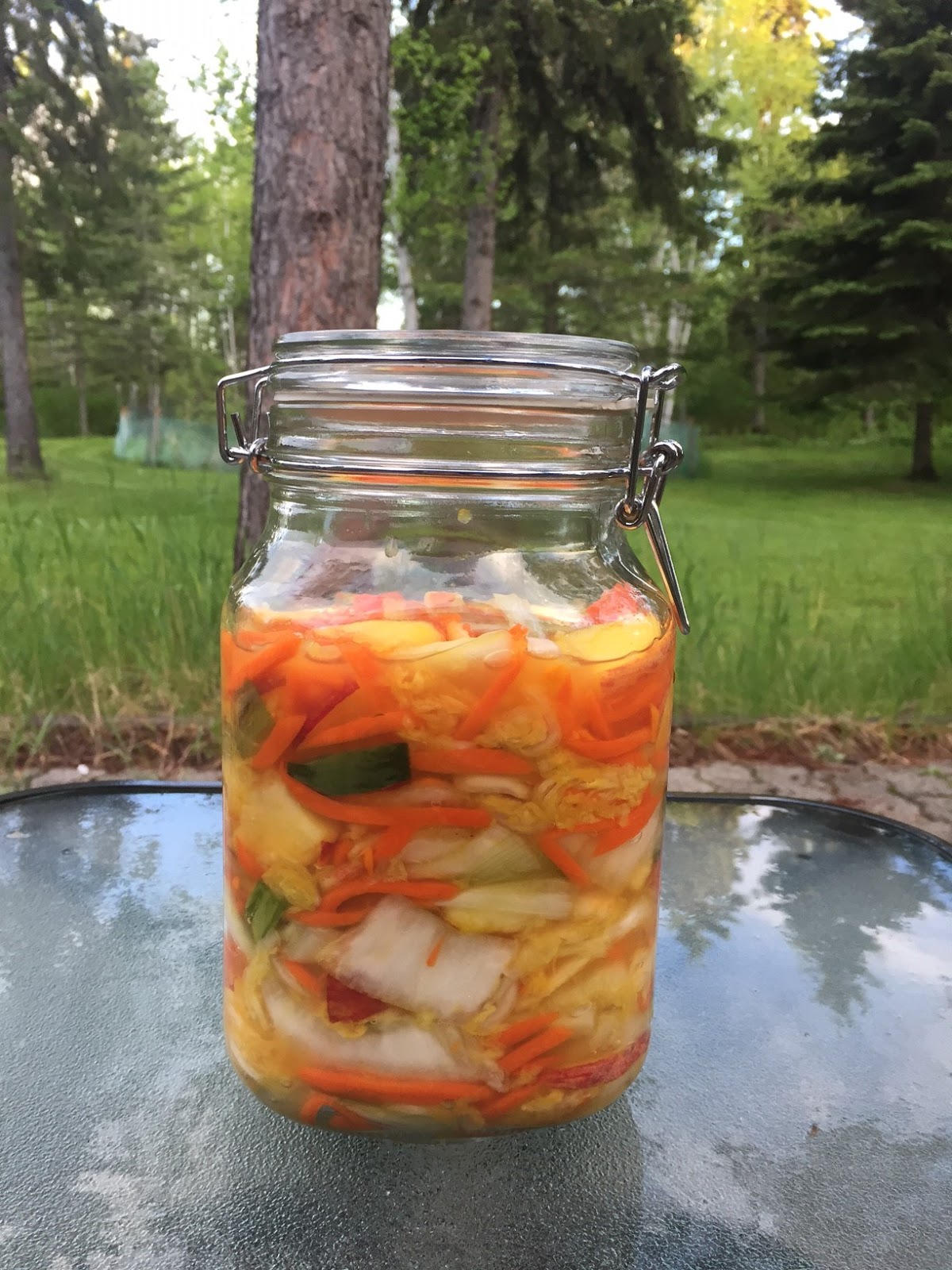
Since I didn't have all the above ingredients this week, I varied the above recipe a little. I added 2 carrots instead of 1. I added 2 apples instead of the ginger. I used green onions from my Tower Garden instead of regular white onions and I omitted the red chili flakes. We will see how it tastes but I totally went on how I was feeling and what I was craving!


Carrots cut using a mandolin


Fresh Tumeric


Tumeric...I can't say enough about tumeric and its amazing qualities. Dr. Mercola has a wonderful article on tumeric:

Tumeric: The Spice That Actually Doubles as a Powerful Anti-Inflammatory


If you are a person who spends a lot on your nails, look out when cutting fresh tumeric!  One of my fellow Fermentationists Certification classmates, Karen Dosha, had her nails done the day before she made hers! 


Karen Dosha's Nails after making her Tumeric Chee


Voila, here is my own version of Tumeric Chee. You really can't go wrong and if you don't have all the ingredients, that is ok!
Tina's Tumeric Chee in Fido Jar


What is nice about the Fido Jars is they allow the gases to escape and keep the bugs out as well. The most important thing here is to use weights so all the vegetables are below the brine. You may buy glass weights through Amazon or you can find a jar that fits snuggly on top however you don't get the anaerobic environment using this method.

Progress:

Batch #1

06.06.2016: Start date ~ used 1 Tbsp of salt but went by taste. Not too salty at all.
13.06.2016: Anticipated harvest date

19.06.2016: Harvested today.  Tastes yummy!
07.08.2016: None left!  It was a hit in my household.

Batch #2

13.09.2016: Start date ~ I had just over 3 lbs of napa cabbage so I trippled the recipe plus I used more tumeric this time and fresh celery from my Tower Garden!  I measured 3 tbsp of Hymalayan Sea Salt but went by taste and used 2.5 tbsp.
20.09.2016: Anticipated harvest date


Thursday, May 26, 2016

Fermentationist Certification: Ferment 1a ~ Sauerkraut

Ingredients:

Mermaid Sauerkraut

Mermaid Sauerkraut (makes 1 quart)

1.25 pounds cabbage
1/8 Cup hijiki, kelp, or wakame seaweed
1 clove garlic
1/4 Cup onion
1 Tablespoon jalapeño
2 teaspoons sea salt (non-iodized)
Raw, unpasteurized sauerkraut has many health benefits. It builds your internal biological terrain, adds probiotics to your intestines, increases alkalinity, and helps you absorb nutrients more effectively. Once you add wild edibles like seaweed, you get the thyroid nourishing, heavy metal detoxing, and radiation protecting powers of this amazing mineral-rich food. 


Tangy Coleslaw

Tangy Coleslaw (makes 1 quart) 

.75 Pounds cabbage
1 carrot
1 celery rib
1/4 Cup daikon radish
1 parsley sprig
3 Tablespoons chopped onion
1 Tablespoon ginger
1 Tablespoon turmeric fresh (1/2 teaspoon dry)
1 clove garlic
1 Tablespoons sea salt (non-iodized)
Celery is known for its high levels of naturally occurring sodium. This helps re-balance electrolytes and blood. Daikon is noted for its weight loss powers. Parsley supports the kidneys. Turmeric works to support the body’s inflammatory response and the liver. Ginger helps soothe digestion and guides the medicinal effects of the other foods deeper into the cells. 


It can be as simple as cutting up cabbage and adding salt!


How to Ferment Vegetables:
1.     Chop the vegetables into similar sized chunks or shreds and put into a bowl. 
Ingredients for Mermaid Sauerkraut
2.     Add salt and mix throughout using your hands to massage the mixture.  There is no need to over massage.   
3.     Begin packing into a half-gallon crock or jar. I purchased mine from Cultures For Health.  Use your fist or a wooden tamper.
4.     Create an anaerobic environment by getting all air bubbles out as you pack it down.
5.     Push until the brine starts to rise to the top of the veggies. 
6.     Place a saucer or plate on top of the vegetables. Try to get one that fits as close to the edges as possible.  The best vessels are ones with no edges on them!
7.     Put a weight on top of that. A jar of water works well.   My weights came with the Fermented Vegetable Master.  Alternatively you can purchase Pickle Pebbles from Amazon.com.
8.     Cover with a cloth so no bugs get inside.  I used an airlock system to keep the smell out of the house.  This also helps to prevent mould from forming.  You can also purchase  them on Amazon.com.
9.     During the first week, push it down daily to help keep the veggies under the brine. Sometimes it takes a day or two to get the brine to stay above the veggies. This will help prevent mould from forming. 
10. Taste it after a week and see if you like it. You can let it ferment as long as you want, but most people prefer 2-4 weeks of fermentation time in small one-gallon batches. When it is too young, it still has a carbonated feeling on your tongue. This will disappear after about a week of fermentation.
11. The best temperature to ferment sauerkraut is 13-18 degrees Celsius. Put it in a pantry, root cellar, cupboard, or on your kitchen counter. If it gets below or above this temperature it will be fine, but the best flavors develop within this range. 
12. When it is ready, scrape off the top layer and enjoy the fresh healthy goodness.
Note: If mould forms, not all is lost. This is a test of your senses. Scrape off the mould and compost it. If the sauerkraut underneath smells okay, taste it. If it tastes off, spit it out!


Progress:
19.05.2016:  Start Date - Mermaid tasted yummy but I think I put too much salt in the Tangy Coleslaw 24.05.2016:  First Tast Check - Both tasting yummy!26.05.2016:  Mermaid Sauerkraut tastes great and is very crunchy.  Tangy Coleslaw is my favourite thus far!      06.06.2016:  Finding it a little salty still.  I will definitely use less salt next time.               09.06.2016:  Anticipated Harvest Date but decided to leave it a little longer 12.06.2016:  Still quite salty
15.06.2016: Harvested ~  I found both of these too salty .  I used Himalayan Sea Salt so I will start looking more closely at my salt portions.